The Norwegian Viola Festival has carried out a national survey of the ratio between violin and viola pupils at Norway’s municipal music and arts schools (kulturskoler).
The survey is based on replies from 112 music schools in municipalities that together cover 69 per cent of Norway’s population – most of the large cities and many municipalities of different sizes, spread all over Norway. There is therefore reason to believe that the results are representative of the whole country.
The results reveal a striking imbalance:
There are about 16 violin pupils for every single viola pupil! In a symphony orchestra, the ratio is about 2.5:1.
Even more striking: almost 70 per cent of the schools that replied do not have a single viola pupil.
| Main results | Number |
|---|
| Violin pupils | approx. 3,388 |
|---|
| Viola pupils | approx. 208 |
|---|
| Ratio of violin to viola pupils | approx. 16:1 (16.3:1) |
|---|
| Schools in the overview | 112 |
|---|
| Schools with viola pupils | 34 |
|---|
| Schools with no viola pupils | 77 (69 %) |
|---|
Viola pupils make up only 5.8 per cent of all violin and viola pupils at the schools that replied.
But what do these figures really mean? Why is the gap so large, what are the consequences for musical life, and what can we do to change the situation?
Why was the survey carried out?
It is well known that many children’s, youth and amateur orchestras in Norway lack violists. These orchestras depend largely on musicians from their own local area and cannot simply recruit from other countries.
The situation is different for professional orchestras. Norway’s symphony orchestras are attractive workplaces for musicians from all over the world and, through international auditions, can attract many highly qualified candidates.
But a strong and sustainable Norwegian musical life also needs its own recruitment base. Norway should be able to train more of the orchestral musicians and soloists of the future, rather than always depending on recruiting them internationally.
To work on the challenge in a targeted way, we first need to know how big it is.
The Norwegian Viola Festival therefore contacted the Norwegian Directorate for Education and Training (Utdanningsdirektoratet) to find out whether national statistics on violin and viola pupils already existed. The answer was that their statistics only show the number of pupils receiving music tuition.
The festival therefore launched its own survey.
How the survey was carried out
The aim of the survey was to show the ratio between the number of violin and viola pupils at music schools in Norway. Requests were therefore sent to 229 municipal music schools that, according to their websites, offered violin lessons. Schools that did not list string tuition were not contacted. Each school was asked three questions:
- How many violin pupils does the school have?
- How many viola pupils does the school have?
- Does the school offer viola lessons?
Replies were received from 112 music schools – 48.9 per cent of those contacted. The survey was carried out from August to November 2026.
As far as the Norwegian Viola Festival knows, this is the most comprehensive survey available of the ratio between violin and viola pupils at Norway’s municipal music schools. The aim is to give musical life a concrete knowledge base for discussing recruitment and developing long-term measures.
Why is this a problem for the whole string community?
A classical orchestra needs a specific number of musicians in each instrument section, and all the musicians in the orchestra must play at a comparable level.
An orchestra’s artistic quality depends not only on how good its best musicians are, but also on the balance and interplay between the sections. To reach a high and even standard, an orchestra needs a sufficient recruitment base in every section.
If one section has far fewer musicians to choose from, this can limit the development of the whole orchestra. One of the most effective ways to raise the overall level of a string section may therefore be to strengthen the section with the weakest recruitment base.
In many orchestras, the viola section is weaker than the violin sections. The main reason is that there are far fewer potential candidates who can develop into skilled orchestral musicians and outstanding soloists.
A larger recruitment base gives more children the chance to develop their talent and increases the number of qualified musicians orchestras can later recruit from.
Strengthening viola recruitment is therefore not only in the interest of violists. It is in the interest of the whole string community.
What ratio of violin to viola pupils should we have?
The answer depends on how we see the viola’s role in musical life.
2.5:1 – if we think mainly of the needs of orchestras
In many symphony orchestras the ratio of violinists to violists is about 2.5:1, depending on scoring and repertoire. If the goal is to secure a good recruitment base for the orchestras of the future, it may be natural to work towards a similar distribution of violin and viola pupils.
The distribution of pupils does not have to match orchestral line-ups exactly, but 2.5:1 can be a long-term guiding goal. Today’s ratio of 16:1 shows how far we are from such a balance.
1:1 – if we think of the viola as an equal solo instrument
Here a different question arises. Among musicians and audiences alike there is a widespread belief that the violin is better suited as a solo instrument than the viola. But has the viola ever been given the same opportunities to develop its artistic potential?
When about 16 times as many children play the violin as the viola, how can we expect the two instruments to produce equally many outstanding soloists at the highest international level?
A ratio of 1:1 therefore represents an interesting long-term artistic vision of a more equal recruitment base. It is not a realistic goal in the short term. The point is to show how different the starting conditions are today.
Even with equal numbers of pupils, the instruments’ opportunities would not automatically become equal. Repertoire, teaching traditions, instrument development and concert opportunities would also need to be strengthened.
The fact that there are fewer outstanding viola soloists than violin soloists is not in itself proof that the viola has less artistic potential. It may also be a consequence of the very different conditions under which the two instruments have developed.
How many more viola pupils would this mean in Norway?
If the survey results reflect the situation across the country, we can make a simplified national estimate by scaling the number of violin pupils by the responding municipalities’ share of the population, about 69 per cent, and applying today’s ratio of 16:1.
| Hypothetical national scenario | Pupils |
|---|
| Violin pupils | approx. 4,910 |
|---|
| Viola pupils at today’s ratio (16:1) | approx. 310 |
|---|
| Viola pupils at 2.5:1 | approx. 1,960 |
|---|
| Estimated increase at 2.5:1 | approx. 1,660 |
|---|
| Viola pupils at 1:1 | approx. 4,910 |
|---|
| Estimated increase at 1:1 | approx. 4,600 |
|---|
A ratio of 2.5:1 would thus mean about 1,660 more viola pupils than the estimated current level. A ratio of 1:1 would mean about 4,600 more.
These are hypothetical worked examples, not documented national pupil numbers or established shortages. They illustrate how large the gap is between today’s situation and the two long-term perspectives.
Why can’t most children just start on the violin, and some switch to the viola later?
Traditionally, viola recruitment has largely relied on children starting on the violin and some later moving to the viola. Many fine violists have followed this path. Some discovered the viola only as teenagers or students and went on to become outstanding professional musicians.
But can we build a long-term recruitment strategy on the hope that enough violinists will one day choose to switch instruments? We have already tried this for many decades, and the shortage of violists is still extremely large.
When a child has played the violin for several years, they have already developed skills, a repertoire, a musical identity and often a social circle connected to the instrument. Moving to the viola therefore involves more than learning to read the alto clef and play a larger instrument. The pupil must want the change, get used to a different sound and adapt their technique – and stay motivated to keep developing on the new instrument.
For many, it will feel natural to continue with the violin, in which they have already invested years. It is therefore by no means certain that a large number of violin pupils will later produce a large enough number of violists.
If recruitment relies mainly on such switches, it depends on enough pupils both wanting and getting the chance to change. This is hard to plan and can vary considerably between schools and orchestras.
Often the need only becomes visible when a children’s or youth orchestra lacks violists. Violin pupils may then be encouraged to switch to fill an empty seat. If it is mainly pupils who are struggling on the violin who are asked, this can also reinforce the idea that the viola is an instrument for those who don’t succeed on the violin.
In this way, viola recruitment risks becoming random and driven by orchestras’ immediate needs, instead of building an independent and stable community of pupils.
There is also a geographical challenge: in small municipalities there may be few violin pupils in each age group. Even if some eventually want to switch, it may not happen when the orchestra needs them.
This traditional practice has existed for generations. Even so, the survey shows that almost 70 per cent of the schools that replied still do not have a single viola pupil. This suggests that switching from violin to viola, as recruitment has worked until now, has not been enough to create a large and stable recruitment base.
As long as most children are steered towards the violin from the start, and the viola is only presented as an alternative later, it will be hard to build a sustainable viola community.
This does not mean that violinists should stop moving to the viola. Such switches can be both valuable and successful. But they should supplement recruitment, not be its foundation.
If we want more violists in the future, we must start by inviting more children to choose the viola as their very first instrument.
Is a better balance possible? What Asker Music School shows
Asker Music School stands out clearly in the survey.
| Violin pupils | Viola pupils | Ratio |
|---|
| Asker Music School | 74 | 25 | approx. 3:1 (25.3 % viola) |
|---|
| The other schools combined | approx. 3,314 | approx. 183 | approx. 18:1 |
|---|
For many years Asker Music School has worked deliberately to present the viola as an independent instrument of equal standing. The school has a large range of violas in different sizes for pupils to rent, so children can start directly on the viola from the age of six.
New pupils are actively invited to choose the viola on an equal footing with violin, cello and double bass. Viola pupils also get chances to perform as soloists and to take part in advanced programmes, UKM (a national youth arts festival) and other musical activities.
The result is a far more even distribution of violin and viola pupils than at the other schools that replied. The experience in Asker suggests that active recruitment, good access to instruments and artistic opportunities can lead to a much better balance.
The example also shows why it matters to recruit children directly to the viola rather than depending on violinists switching later.
The viola as a solo instrument – potential and prejudice
Is the viola just a joke – or a fully fledged solo instrument?
The viola is often judged by the acoustic and technical qualities of the violin. There are professional discussions about the viola’s size relative to its register and the acoustic compromises this involves. But different acoustic properties do not necessarily mean different artistic value.
The viola has its own sound, character and expressive possibilities. It does not need to imitate the violin to be a fully fledged solo instrument.
Even so, the instrument has long been the target of negative stereotypes and so-called viola jokes. Many of them rest on the idea that violists are less skilled musicians than violinists, or that the viola is for those who don’t succeed on the violin.
Why have such jokes gained such a strong place in musicians’ culture? And why do we accept an instrument and its players constantly being portrayed as inferior? Is it just harmless humour, or do the jokes help keep alive the idea that the viola really is a lesser instrument?
For established professionals with a secure artistic identity, such jokes may be easy to shrug off. But for children and young people choosing an instrument, they can send a very different signal. If the viola is seen as less attractive, less respected or less “cool” than the violin, why would young musicians want to choose it?
The survey does not measure what such attitudes mean for the choice of instrument. But it is important to ask whether negative ideas help sustain weak recruitment.
Why do young violists in orchestras so rarely get to play the melody?
Throughout music history, instruments in ensembles have often had different roles. In the Baroque era especially, clear melodic upper voices and a bass line forming the harmonic foundation through basso continuo were common. The inner voices often had a filling-in role, although the music also contained independent, contrapuntal part-writing. Later, orchestral and chamber music developed towards greater melodic independence for every instrument.
Today there is no artistic necessity for the first violin always to play the melody while the viola mainly accompanies. Yet this division of roles lives on in many educational arrangements for children’s and youth orchestras. The violins often get the most recognisable tunes, while the viola plays long notes, rhythmic figures or accompaniment.
These parts can be musically important, but they are not always as motivating to practise alone. The musical context often only becomes clear when the whole orchestra plays together. A violin pupil can come home and play a well-known tune for the family; a viola pupil may only have an accompanying part to show.
This is not about accompaniment being less valuable, but about children needing varied musical challenges, independent melodic tasks and the chance to experience mastery. If the viola is to become more attractive, young violists must also get to play melodies and solo pieces that bring joy and motivation.
Why is there so much less original music for viola?
Over several centuries the violin has developed an extensive original repertoire, from beginners’ pieces to great virtuoso works. The viola has a much smaller original repertoire. Much of the music violists perform as soloists consists of transcriptions and arrangements of works originally written for violin, cello or other instruments.
Such transcriptions can have great artistic value. But they cannot replace the need for a rich repertoire composed specifically for the viola’s sound, technical qualities and expressive range.
The limited original repertoire may also be linked to the small number of viola soloists. When fewer musicians commission, perform and promote new works, composers may be more inclined to write for instruments with larger communities of players and more concert opportunities. At the same time, a smaller repertoire gives violists fewer artistic choices.
This creates a self-reinforcing cycle: few soloists mean less demand for new compositions, while a limited original repertoire makes it harder to develop and showcase new soloists. If the viola is to strengthen its position as an independent solo instrument, more original music is needed at every level – from children and young people to music students and professional soloists.
How can the viola become more visible in society?
The viola is an important part of the orchestra’s overall sound, but its own voice is not always easy for audiences to pick out. Often it is the top melodic line that is heard most clearly. When the viola appears as a solo instrument, however, audiences can experience its distinctive sound and expression directly.
Solo performances can therefore be a particularly effective way to make the instrument better known and more attractive. This is all the more important because the viola looks so similar to the violin. Many audience members do not know the difference between the instruments and know little about the viola’s character.
When young musicians hear inspiring viola soloists, play interesting solo pieces and perform as soloists themselves, they can develop a stronger identity as violists. More soloists are thus not just an artistic goal; they can also become an important driver of better recruitment.
How can children start on the viola without good instruments in their size?
The violin has an established standard size for adults. The viola, by contrast, comes in many sizes, often with body lengths from about 39 to 43 centimetres, and some instruments are even larger. Violists have to balance the instrument’s size, tonal qualities, playability and ergonomic demands.
For children it is particularly important to have access to good violas in smaller sizes, so they can start directly on the instrument. Instrument making is also shaped by demand. When the market is limited, makers and manufacturers may have weaker financial incentives to develop a wide range of good violas, especially for children.
Limited access to instruments can in turn make it harder for music schools to recruit new pupils. Instrument making and recruitment thus influence each other.
Why must several areas be developed at the same time?
The challenges of recruitment, teaching, solo opportunities, repertoire, instrument making and attitudes are closely linked. A small recruitment base produces fewer potential soloists. Few soloists can mean less demand for new compositions and fewer concerts. Limited visibility can sustain negative ideas about the instrument, while low demand can make it harder to develop and supply good instruments. Together, these factors can make it even harder to recruit new pupils.
To reverse the trend, it is therefore not enough to work on just one area. More pupils, better teaching, more soloists, more original music, better access to instruments and greater visibility must be developed in parallel.
A larger recruitment base can produce more soloists, who in turn create interest in new compositions and more concerts. Greater visibility can increase demand for instruments and inspire more children to choose the viola. The goal must be a positive cycle in which recruitment and artistic opportunities strengthen each other.
A local, national or international problem?
Is the shortage of violists a local, national or international problem? The answer is that the challenge exists at all three levels.
Local – because children’s, youth and amateur orchestras need violists
It is at the local level that the shortage is felt most directly. These orchestras depend on musicians from their own area. When almost 70 per cent of the schools that replied do not have a single viola pupil, it becomes difficult to build stable local viola communities.
In some municipalities a single viola pupil may be the only one playing the instrument at their school. This limits the chance to play with other violists, build a social circle and feel the same sense of belonging as pupils in larger sections. It also makes it hard for local orchestras to build balanced line-ups over time.
National – because Norway needs its own recruitment base
Through international auditions, Norway’s professional orchestras can attract excellent musicians from all over the world. This is a strength and gives good opportunities to meet the need for highly qualified violists. But the ability to recruit internationally should not replace the ambition to develop Norway’s own musicians.
A stronger national recruitment base would give more young people the chance to pursue the viola, strengthen music education and help ensure that Norway can continue to develop professional orchestral musicians and soloists in the future.
International – because the imbalance also exists in other countries
The Norwegian survey shows about 16 violin pupils per viola pupil. German statistics show a ratio of about 15:1. This gives reason to believe that the challenge extends beyond Norway.
If many countries have a similar imbalance, the underlying challenge cannot be solved simply by orchestras recruiting musicians from each other. International recruitment can meet the needs of individual orchestras, but it does not in itself increase the total number of violists being trained. Recruitment must therefore be strengthened locally, nationally and internationally.
What can we learn from Germany?
As part of the survey, the Norwegian Viola Festival also looked for similar statistics from other countries. In Germany, the Association of German Music Schools (Verband deutscher Musikschulen, VdM) collects pupil numbers from its member schools every year. The 2024 figures show:
| Instrument | Pupils |
|---|
| Violin | 68,608 |
|---|
| Viola | 4,613 |
|---|
That is about 15 violin pupils per viola pupil. The German figures also show a positive trend: from 2014 to 2024 the number of viola pupils rose by 21.7 per cent, while violin pupils fell by 6.4 per cent, improving the ratio from about 19:1 to 15:1.
Why is the comparison particularly interesting?
Norway has many small municipalities, a scattered population and long distances. This can make it difficult to build large enough local communities for less common instruments such as the viola. Germany generally has a much higher population density, with more towns and cities within shorter distances.
When the ratio of violin to viola pupils is as skewed as 15:1 there too, it suggests that the challenge cannot be explained by Norway’s geography alone.
The Norwegian survey and the VdM statistics differ in method and coverage, so the figures cannot be compared as if they were part of one joint study. Even so, both show a considerable imbalance and underline the need for better international data.
Source: Deutsches Musikinformationszentrum (2026), “Schülerzahlen der Instrumental- und Vokalfächer an öffentlichen Musikschulen” ↗, based on VdM statistics.
How big could the challenge be in Europe?
If we hypothetically assume that the distribution of pupils at the German VdM music schools also applies to Europe as a whole, the figures can illustrate how large the recruitment challenge could potentially be. With about 745 million inhabitants in Europe and 84.6 million in Germany in 2024, simple population scaling with the German ratio of 15:1 gives the following scenario:
| Hypothetical European scenario | Estimate |
|---|
| Violin pupils | approx. 604,000 |
|---|
| Viola pupils at 15:1 | approx. 40,000 |
|---|
| Estimated increase at 2.5:1 | approx. 201,000 |
|---|
| Estimated increase at 1:1 | approx. 564,000 |
|---|
These are not documented European pupil numbers or actual shortages. The calculation rests on a simplified assumption that the German VdM figures can be scaled by population, even though countries’ music-school systems and participation vary considerably. The figures therefore mainly illustrate the possible scale of the challenge, and why dedicated surveys are needed in more countries.
Sources: Deutsches Musikinformationszentrum and UN World Population Prospects 2024.
What can be done to strengthen viola recruitment?
The Norwegian Viola Festival believes that lasting improvement requires a long-term, comprehensive effort. The following measures are especially important:
- Active recruitment of beginners. The viola must be presented as a natural first choice, not just as an instrument to switch to from the violin.
- Dedicated places for viola pupils. Music schools should consider reserving places and working actively to fill them.
- Qualified teaching and clear role models. More teachers with viola as their main instrument can strengthen both teaching and pupils’ identity as violists.
- Good violas in smaller sizes. Music schools and instrument makers should work together to make instruments available to children.
- More original music for viola. New works are needed at every level, from beginners to professional soloists.
- Better educational arrangements. Young violists should get melodies, independent parts and varied musical challenges.
- More solo opportunities and meeting places. Children and young people need concerts, chamber music, advanced programmes and contact with other violists.
- Countering negative stereotypes. The viola must be presented as an attractive instrument of equal artistic worth.
- Systematic follow-up. Music schools and music organisations should record developments and consider long-term recruitment targets.
Short-term projects can spark interest, but lasting improvement requires systematic effort and cooperation between music schools, orchestras, composers, instrument makers and concert promoters.
How can the Norwegian Viola Festival contribute?
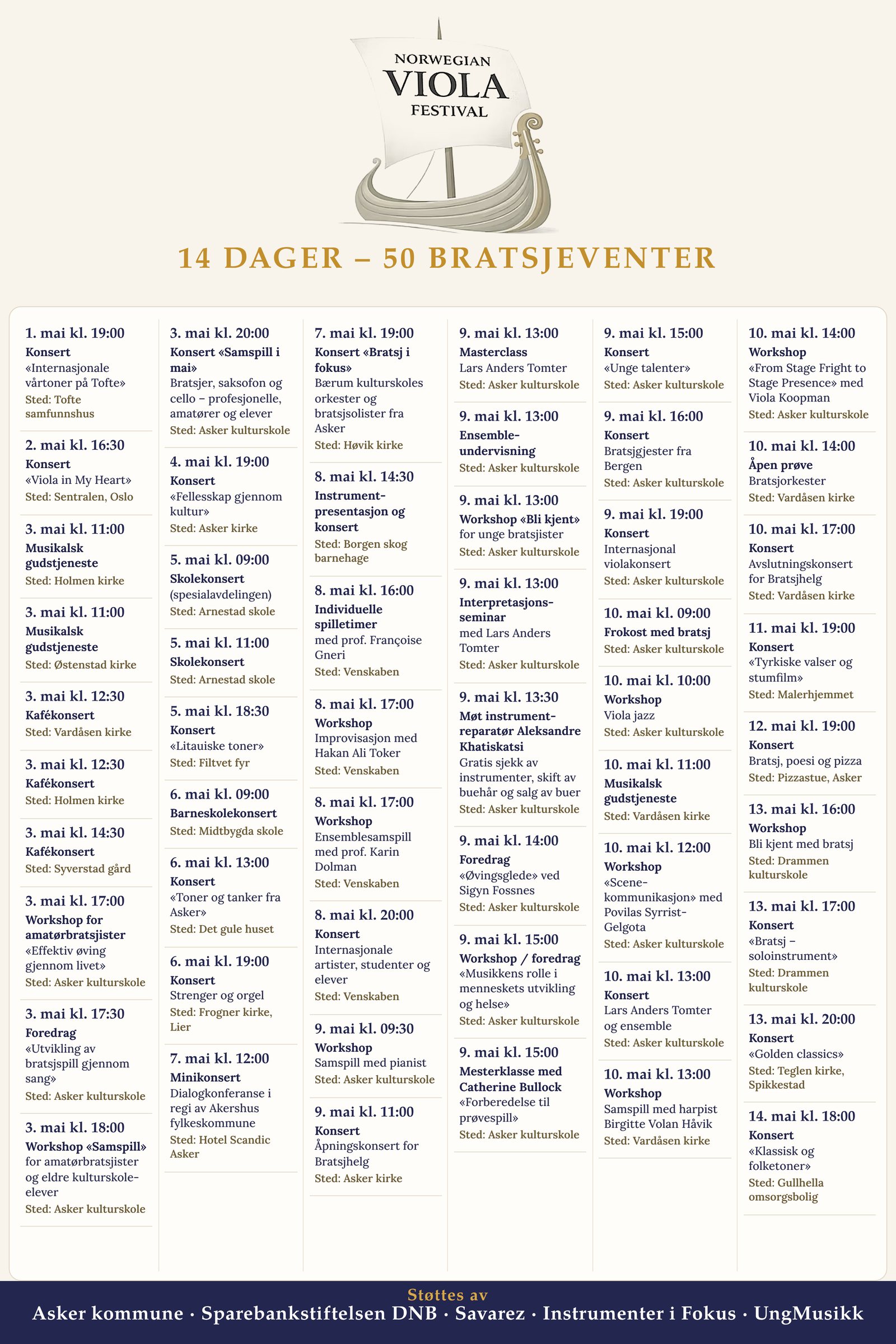
The Norwegian Viola Festival grew out of the Viola Weekend at Asker Music School and has developed into an event lasting about 14 days across several venues. The festival brings together Norwegian and international artists, children, young people, music students and amateur musicians for concerts, teaching and ensemble playing. For pupils who are the only violist at their school, such meeting places can be especially valuable.
The festival aims to strengthen the viola community, inspire young musicians, showcase the instrument’s artistic possibilities and foster interest in original music written for the viola. At the same time, it wants to put the recruitment challenge on the agenda as an issue for the whole string community.
Why do we need similar surveys in more countries?
The Norwegian survey provides an important knowledge base for further recruitment work. Replies were received from 112 music schools, and the municipalities covered represent an estimated 69 per cent of Norway’s population. The material covers large cities, medium-sized and small municipalities. As far as the Norwegian Viola Festival knows, no comparable national survey of this scope has been carried out before.
We hope the survey will inspire the Norwegian Council for Schools of Music and Performing Arts, music schools, orchestras and other music organisations to record pupil numbers by instrument and follow developments over time. We also hope that organisations in other European countries and the rest of the world will carry out similar surveys.
The better we know the real situation, the better the basis for setting concrete, realistic and long-term recruitment goals.
Should we accept the situation – or give the viola a better future?
The survey shows that the viola has a very limited recruitment base compared with the violin. In the short term this is felt especially in local children’s, youth and amateur orchestras. In the longer term it can affect the development of professional orchestral musicians, soloists, original repertoire and instrument making.
The comparison with Germany shows that a considerable imbalance also exists outside Norway. This makes recruitment a challenge that deserves attention both nationally and internationally.
But this is not just a problem for violists. When one section has a very limited recruitment base, it can affect the quality and development of the whole orchestra. Strengthening viola recruitment is therefore an investment in the future of the entire string community.
The traditional strategy – most children start on the violin and some later move to the viola – has existed for generations. Yet the survey shows an imbalance of as much as 16:1. If the situation is to change, the viola must have a more independent place from the very beginning of music education.
More children must have the chance to choose the viola as their first instrument. At the same time, they must meet qualified teachers, good instruments, inspiring repertoire and real opportunities to develop as both orchestral musicians and soloists.
The experience of Asker Music School shows that a better balance is possible through targeted, long-term work.
The Norwegian Viola Festival wants to help build a stronger, more sustainable viola community – with more pupils, more soloists, more original music and greater artistic opportunities. The aim is not only to secure enough violists for the orchestras of the future, but also to give the viola better conditions for producing outstanding soloists and gaining greater visibility and recognition in musical life and society.